The Truss Is the Bridge
The Roof Gets the Attention; the Frame Does the Work
The roof gets the attention; the truss does the work. How a triangulated frame turns bending into tension and compression, and why that lets timber span further than a beam.
A covered bridge is named for its enclosure, photographed for its enclosure, and argued over because of its enclosure. The truss inside is the reason it stands.
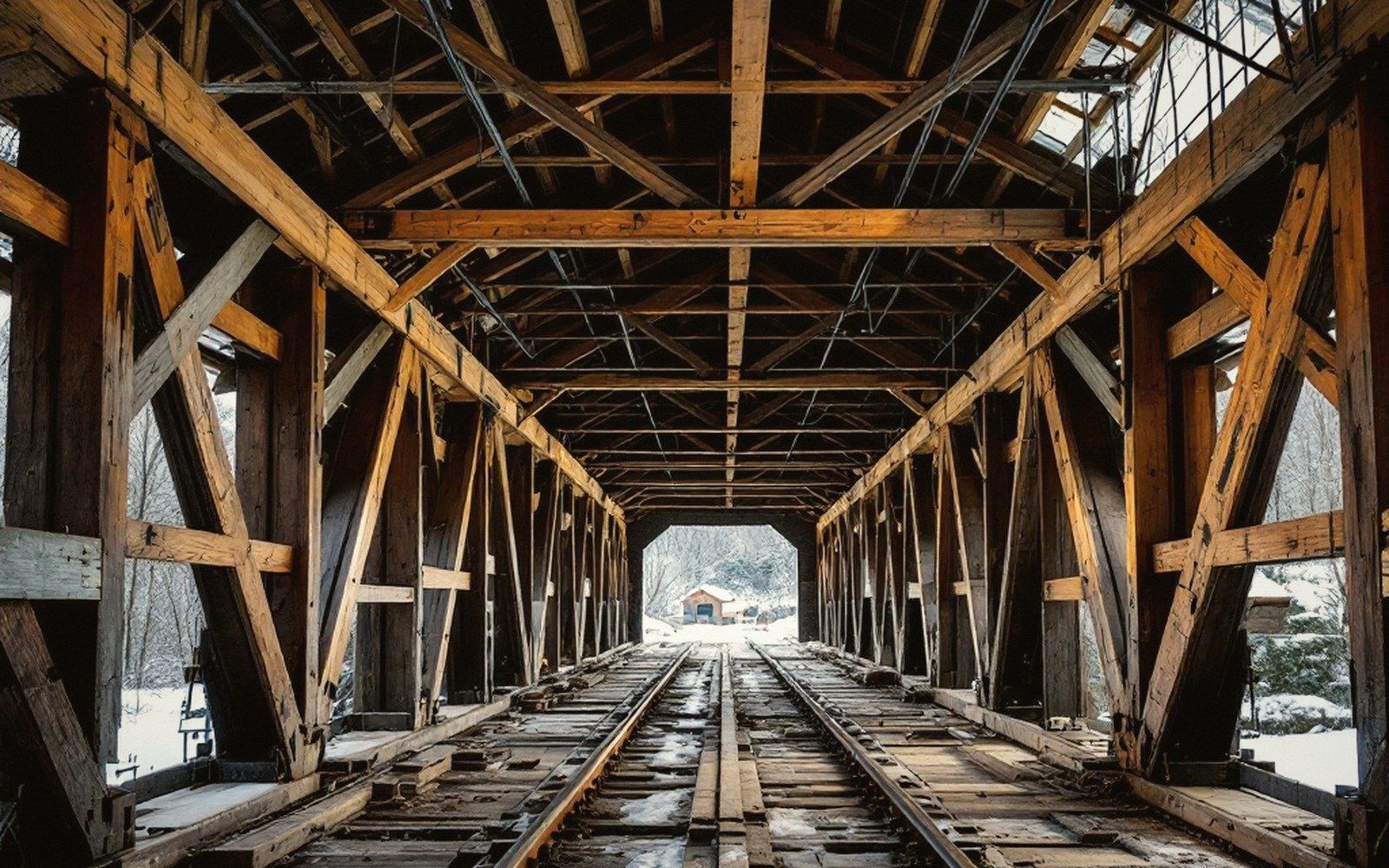
Strip the boards away and what remains is a triangulated timber frame — two of them, one on each side, connected across the top and bottom, spanning whatever width of creek or gorge the builder needed to cross. That frame is the bridge. The roof and siding are maintenance decisions. The truss is the structure.
The problem with spanning a gap using a single horizontal timber is bending. Push down on the middle of a beam and it tries to sag. The top face is being crushed — compressed — while the bottom face is being stretched — put in tension. Wood handles compression reasonably well along the grain. It handles tension along the grain well too. What it resists poorly is the combination: the shear, the cross-grain stress, the cracking that begins wherever the forces are complicated. A long, heavy beam needs to be very deep to resist sagging, and very deep means very heavy, and timber doesn't come in arbitrary sizes.
A truss solves this by replacing the continuous beam with a framework of shorter members, each of which carries its load in a single, clean way — either pushed along its length or pulled along its length. Compression or tension. Nothing curved, nothing bent. The triangle is the geometry that makes this possible, because a triangle, unlike a rectangle, cannot be racked into a different shape without changing the length of a member. It is rigid by nature. Connect a series of triangles between two horizontal chords and you have a structure that takes a load at any point, resolves it into forces in the members, and delivers those forces to the abutments at each end.
In a simple Pratt configuration, the diagonals slope toward the centre and carry tension; the verticals carry compression.
Chord, Post, Diagonal
Every truss has two chords — think of them as the top and bottom rails of the frame. Between them run verticals, called posts, and diagonals. The arrangement of those diagonals determines which members are in tension and which are in compression, and that decision shaped every proprietary truss type that followed.
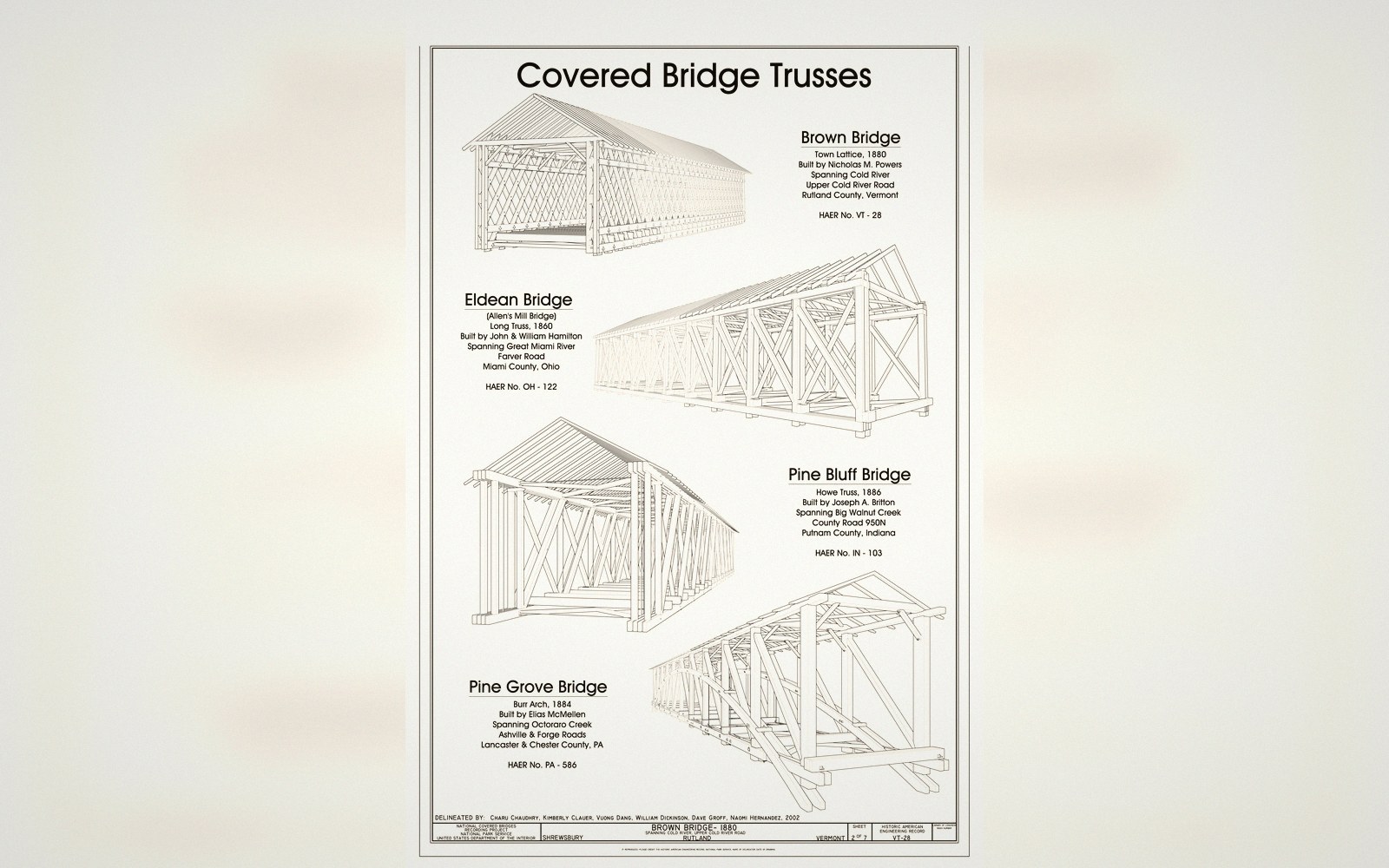
In a simple Pratt configuration, the diagonals slope toward the centre and carry tension; the verticals carry compression. Reverse the slope and you have a Howe, where the diagonals are in compression and iron rods handle the tension. Ithiel Town's lattice replaced posts and diagonals with a dense web of planks crossing at angles, spreading the forces so diffusely that no single member needed to be very large. Theodore Burr added a continuous arch alongside a truss, so the two systems share the job — neither alone carrying the full load.
Each choice carried consequences for the timber: how large each piece needed to be, where the connections fell, which members would eventually show decay first. Bearing points and chord ends accumulate moisture; they are where every truss, regardless of type, begins to weaken. The geometry determines which members are critical and therefore which repairs, years or decades later, are worth the cost.
Span, and What It Demands
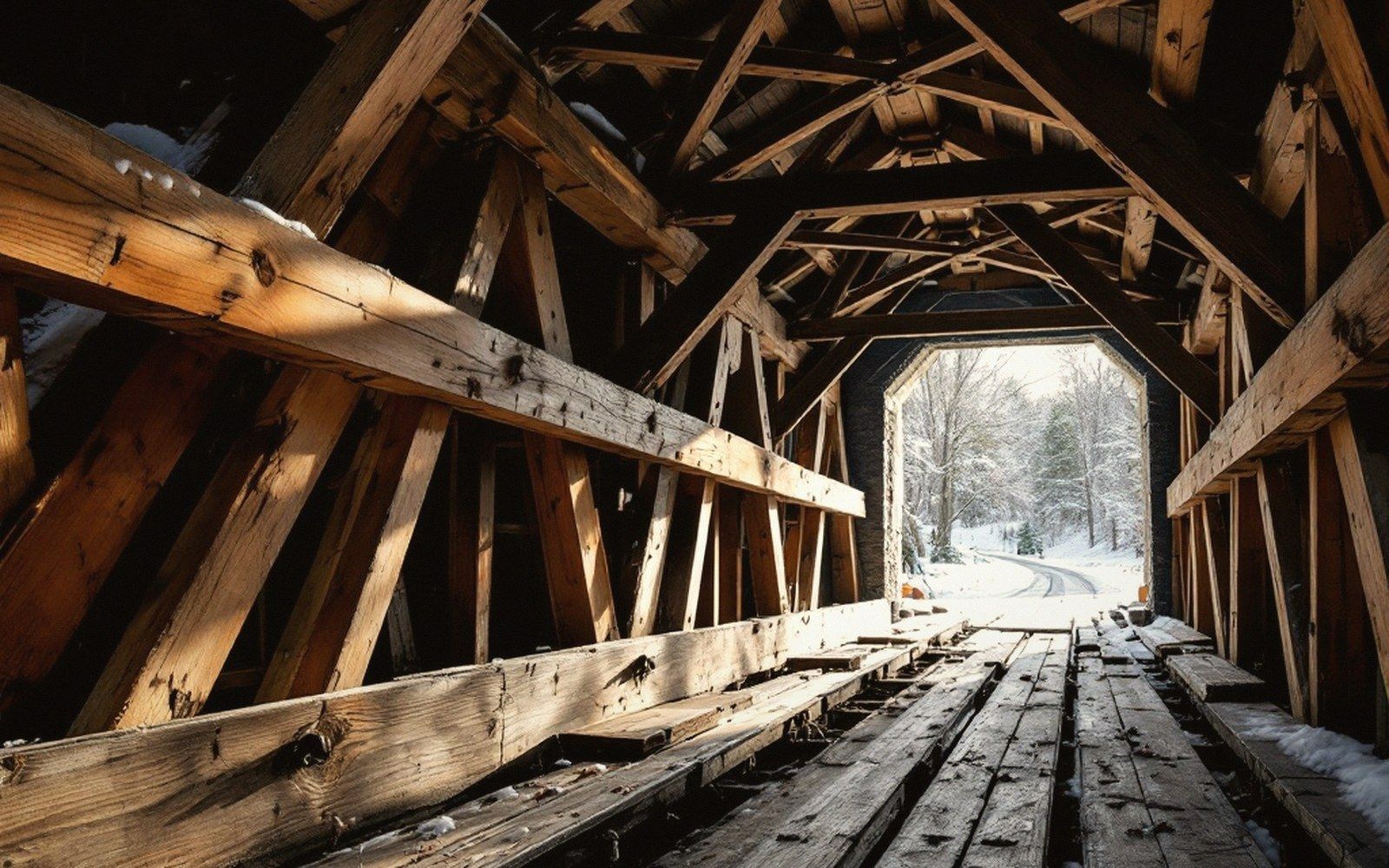
The longer the span, the more severely the forces accumulate in the chords. A short bridge of twenty feet can afford modest timbers and simple joints. Push the span toward a hundred feet — well within the range of many surviving county bridges — and the lower chord, pulled steadily by the load of every wagon and later every truck, must be large, well-jointed, and kept dry. This is precisely why the roof exists at all. Timber that stays dry can carry those forces for generations. Timber that wets and dries and rots at the connections cannot, however well the triangles were laid out.
The enclosure, then, is not decoration or tradition. It is the condition under which the truss can do its job across a useful lifetime. One system protects the other. Neither works well alone.
Dry Timber is an independent guide to covered-bridge engineering. It is not a visitors bureau, tourism body, or preservation society.
More in Trusses
Each type solves a different problem.