Smith and Childs
Proprietary trusses and the kit-bridge era
Later proprietary types sold as kits with instructions. What standardisation did to bridge building.
By the 1870s, the covered bridge was no longer primarily a local craftsman's puzzle. Two patent holders — Robert W. Smith of Ohio and Josiah Childs — had turned truss design into a product, each selling not just a geometry but a complete system: timber dimensions, connection details, and assembly instructions bundled together so that a county could order a bridge the way it might order a piece of farm equipment.
Smith's truss, patented in 1867, relied on a radiating web of diagonal members fanning outward from the lower chord — a form sometimes compared to an arch laid on its side. The geometry distributed load without demanding the precision joinery that earlier designs required. Childs worked a similar logic: simplify fabrication, reduce the skill threshold, and more counties could afford to build. Both systems were proprietary, meaning the patent holder licensed the design and often supplied components prefabricated and measured, ready for local labor to assemble on site.
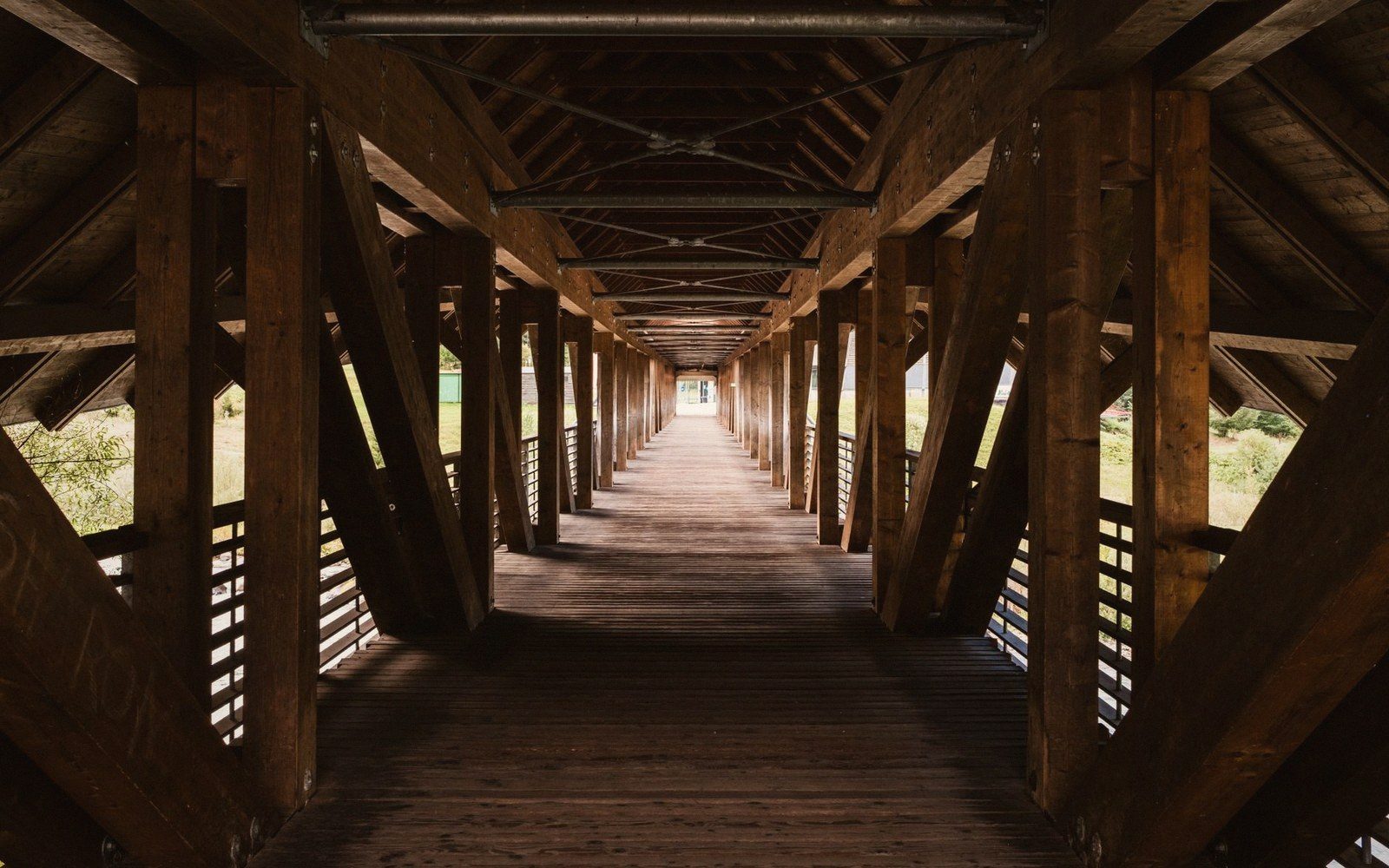
The standardization this produced was real and useful. A contractor who had built one Smith-truss bridge understood the next. Timber could be cut to known dimensions before the site was even surveyed. Errors that crept in when each bridge was essentially a one-off design were reduced. Speed went up; unit cost came down.
What standardization also did, quietly, was shift engineering knowledge away from the locality. The Burr-arch and Town lattice builders had carried their understanding in their hands — every joint cut to fit the specific timber in front of them. The kit-bridge builder followed a specification he had not derived. When something went wrong or a span needed adaptation, the instructions did not always help.
Errors that crept in when each bridge was essentially a one-off design were reduced.
Neither the Smith nor the Childs truss became dominant the way the Burr arch or Howe truss did; the era of timber highway bridges was already shortening, and iron and steel were arriving fast. But the patent types document a real transition: the moment when covered-bridge construction became a transaction rather than a craft, and when a county engineer's job was less to design than to specify and inspect.
Dry Timber is an independent publication about covered-bridge engineering. It is not a visitors bureau, tourism body or preservation society.
More in Trusses
Each type solves a different problem.